Institute of Chemistry, Academia Sinica – Research
Directions
The research thrusts of the Institute are currently grouped along three major directions: materials chemistry, chemical synthesis and catalysis, and chemical biology. The current topics of materials sector include organic electroluminescent materials and devices, organic field-effect transistor materials and devices, photovoltaic materials and devices. The chemical catalysis and synthesis sector is focusing on the development of new synthetic methodology, drug discovery, carbohydrate chemistry, and the development of new catalytic systems for the generation of renewal energies and green fuels. The chemical biology program has made important advances in the delineation of bio-macromolecular structures and the development of new analytical platforms for disease detection and diagnosis.
Materials Chemistry: Organic Electronic and Optoelectronic Materialsy
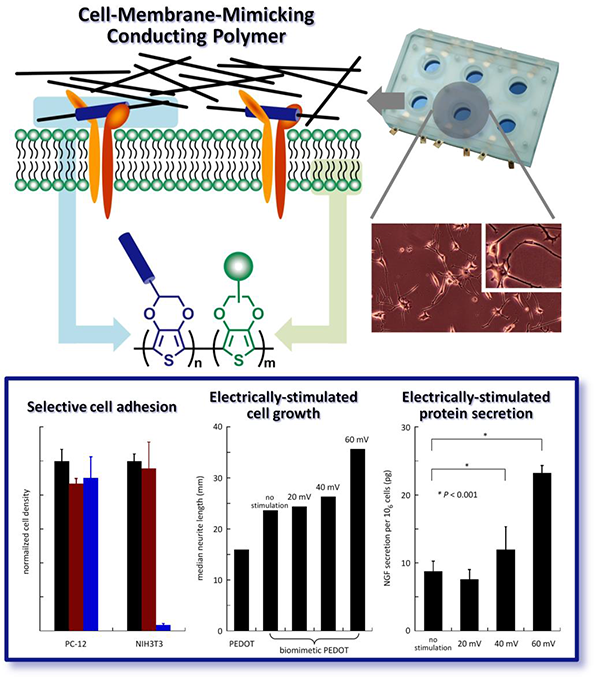
Applications of organic optoelectronic materials and molecular engineering of nanomaterials are two major research directions under the materials division. Noticeable results include developments of blue fluorescent molecular materials for high performance organic light-emitting diodes, rational design of field-effective organic memory devices based on pentacene and gold nanoparticles, the very first stable organic thin film transistor based on single crystal of hexacene, rare single-walled metal–organic nanotube (MONT) with a large exterior wall diameter, the applications of metal-organic framework as optoelectronic materials, and a number of high performance materials for efficient solar energy harvesting devices such as dye-sensitized solar cells, perovskite solar cells, or organic photovoltaics. Researchers in this sector also develop stimuli-responsive materials, core-shell nanomaterials, and biomaterials. A recent report shows that a cell membrane–mimicking conducting polymer is capable to integrate biochemical and electrical stimulation to promote neural cellular behavior with great enhancement of neurite outgrowth on this conducting polymer.
Chemical Catalysis and Synthesis: Green Catalysis and Synthetic Methodology
In response to the increasingly demands of sustainable fuel and green synthetic technology, researchers in the organic synthesis and chemical catalysis divisions have strived to advance the development of cutting-edge technology for chemical transformations. The synthetic chemistry division of this sector focuses on the advances of synthetic methodology and drug discovery. The research topics under catalysis division is reconciling to catalysis relating to renewable energy. Major research directions in this sector include: (1) synthetic methodology: silyl ethers for hydroxy- directed nucleophilic acyl alkylation, microwave-assisted carbohydrate synthesis, smart fluorescent probes for bioorthogonal sugar labeling; (2) coordination chemistry: approaching unconventional catalysis via amino-NHC and carbodicarbene, unconventional porphyrin complexes for small molecule activations, engineering cytochrome P450 BM3 and alkane hydroxylase (AlkB) for alkane oxidations; (3) renewable energy catalysis: catalytic hydrogen evolution and mechanistic studies, encapsulated tricopper cluster for methane to methanol conversion, and novel catalysts for valorization of lignocellulosic biomass feedstocks.
Chemical Biology: New Material and Method towards Sustainable Health
Chemical biology division focus on the development of new material and methodology to explore the structure and function of macromolecules associated with cellular function or human diseases. The research activities are directed to unravel the underlying pathological mechanism and to derive new diagnostic and therapeutic strategies. Research topics in this division cover (1) development of smart biomaterials based on novel molecular principles; (2) chemical probe and advanced techniques in bio-imaging and structural biology; (3) drug discovery in cancer, infectious and neurodegenerative diseases; (4) development of structural biology techniques for infectious diseases, and (5) development of advanced proteomics strategies for biomarker discovery. The major achievements from the chemical biology group include the establishment of multiplexed quantitative strategy for membrane proteomics and post-translational modification for delineating disease mechanism and mining therapeutic targets discovery of amyloid fibrils induced from the TDP-43 in the Amyotrophic Lateral Sclerosis (ALS), and development of a photocontrollable probe to induce TDP-43 aggregates in live cells, mapping of the RNA exit channel on transcribing RNA polymerase II by FRET analysis, development of nano velcro chip to capture circulating tumor cells for liquid biopsy, construction of a near-infrared- activatable enzyme platform using an up-conversion nanoparticle to remotely trigger intracellular signal transduction.
仿細胞膜導電高分子及其於電刺激細胞工程上的應用
Large Enhancement in Neurite Outgrowth on a Cell-Membrane-Mimicking Conducting PolymerNature Communications. 2014, 5, 4523.
Bo Zhu, Shyh-Chyang Luo, Haichao Zhao, Hsing-An Lin, Jun Sekine, Aiko Nakao, Chi Chen, Yoshiro Yamashita, Hsiao-hua Yu.*
利用生物電子元件來進行電刺激神經細胞的生長是一個在再生醫學上很有潛力的研究方向。然而,免疫系統的防衛機制會隔離殖入電極,從而降低了裝置的壽命。理想的生物機電介面的電極材料,不但能夠應該與神經元有選擇性且能高效率地結合之外,並且應該要能盡量減少免疫系統的防衛效應,這在實際應用上相當中重要的。在本論文中,藉由模仿生物細胞膜的功能與分子結構,我們開發了適合生物機電介面電極的新穎導電高分子以及用其組成的奈米薄膜。這種新型的導電高分子奈米薄膜,不但具有高的生物相容性、高水溶液穩定性,同時可以抵擋非專一性的蛋白質以及細胞的吸附,從而辨認和促進與目標細胞的長時間電信號連通。這種材料也具有低電阻抗,可以有效傳遞電訊號並產生生物刺激。藉由這型新穎的材料,我們建構了先進的奈米生物電子界面,並在此界面上利用電刺激的方式,讓神經突觸的增生得到了破紀錄的增強,大幅地提高了神經細胞的分化及成長效率。相同的奈米生物電子界面,也同時運用在利用電流刺激增加蛋白質的分泌的研究以及應用上。
Although electrically stimulated neurite outgrowth on bioelectronic devices is a promising means of nerve regeneration, immunogenic scar formation can insulate electrodes from targeted cells and tissues, thereby reducing the lifetime of the device. Ideally, an electrode material capable of electrically interfacing with neurons selectively and efficiently would be integrated without being recognized by the immune system and minimize its response. In this research article, we develop a cell membrane–mimicking conducting polymer possessing several attractive features. This polymer displays high resistance toward nonspecific enzyme/cell binding and recognizes targeted cells specifically to allow intimate electrical communication over long periods of time. Its low electrical impedance relays electrical signals efficiently. This material is capable to integrate biochemical and electrical stimulation to promote neural cellular behavior. Neurite outgrowth is enhanced greatly on this new conducting polymer; in addition, electrically stimulated secretion of proteins from primary Schwann cells can also occur upon it.