
Main Content
:::

Institute of Chemistry, Academia Sinica – Research

Directions

The research thrusts of the Institute are currently grouped along three major directions: materials chemistry, chemical synthesis and catalysis, and chemical biology. The current topics of materials sector include organic electroluminescent materials and devices, organic field-effect transistor materials and devices, photovoltaic materials and devices. The chemical catalysis and synthesis sector is focusing on the development of new synthetic methodology, drug discovery, carbohydrate chemistry, and the development of new catalytic systems for the generation of renewal energies and green fuels. The chemical biology program has made important advances in the delineation of bio-macromolecular structures and the development of new analytical platforms for disease detection and diagnosis.

Materials Chemistry: Organic Electronic and Optoelectronic Materialsy

Applications of organic optoelectronic materials and molecular engineering of nanomaterials are two major research directions under the materials division. Noticeable results include developments of blue fluorescent molecular materials for high performance organic light-emitting diodes, rational design of field-effective organic memory devices based on pentacene and gold nanoparticles, the very first stable organic thin film transistor based on single crystal of hexacene, rare single-walled metal–organic nanotube (MONT) with a large exterior wall diameter, the applications of metal-organic framework as optoelectronic materials, and a number of high performance materials for efficient solar energy harvesting devices such as dye-sensitized solar cells, perovskite solar cells, or organic photovoltaics. Researchers in this sector also develop stimuli-responsive materials, core-shell nanomaterials, and biomaterials. A recent report shows that a cell membrane–mimicking conducting polymer is capable to integrate biochemical and electrical stimulation to promote neural cellular behavior with great enhancement of neurite outgrowth on this conducting polymer.

Chemical Catalysis and Synthesis: Green Catalysis and Synthetic Methodology

In response to the increasingly demands of sustainable fuel and green synthetic technology, researchers in the organic synthesis and chemical catalysis divisions have strived to advance the development of cutting-edge technology for chemical transformations. The synthetic chemistry division of this sector focuses on the advances of synthetic methodology and drug discovery. The research topics under catalysis division is reconciling to catalysis relating to renewable energy. Major research directions in this sector include: (1) synthetic methodology: silyl ethers for hydroxy- directed nucleophilic acyl alkylation, microwave-assisted carbohydrate synthesis, smart fluorescent probes for bioorthogonal sugar labeling; (2) coordination chemistry: approaching unconventional catalysis via amino-NHC and carbodicarbene, unconventional porphyrin complexes for small molecule activations, engineering cytochrome P450 BM3 and alkane hydroxylase (AlkB) for alkane oxidations; (3) renewable energy catalysis: catalytic hydrogen evolution and mechanistic studies, encapsulated tricopper cluster for methane to methanol conversion, and novel catalysts for valorization of lignocellulosic biomass feedstocks.

Chemical Biology: New Material and Method towards Sustainable Health

Chemical biology division focus on the development of new material and methodology to explore the structure and function of macromolecules associated with cellular function or human diseases. The research activities are directed to unravel the underlying pathological mechanism and to derive new diagnostic and therapeutic strategies. Research topics in this division cover (1) development of smart biomaterials based on novel molecular principles; (2) chemical probe and advanced techniques in bio-imaging and structural biology; (3) drug discovery in cancer, infectious and neurodegenerative diseases; (4) development of structural biology techniques for infectious diseases, and (5) development of advanced proteomics strategies for biomarker discovery. The major achievements from the chemical biology group include the establishment of multiplexed quantitative strategy for membrane proteomics and post-translational modification for delineating disease mechanism and mining therapeutic targets discovery of amyloid fibrils induced from the TDP-43 in the Amyotrophic Lateral Sclerosis (ALS), and development of a photocontrollable probe to induce TDP-43 aggregates in live cells, mapping of the RNA exit channel on transcribing RNA polymerase II by FRET analysis, development of nano velcro chip to capture circulating tumor cells for liquid biopsy, construction of a near-infrared- activatable enzyme platform using an up-conversion nanoparticle to remotely trigger intracellular signal transduction.

研究神經退化性疾病的新平台: 以光控探針誘發致病蛋白在活體細胞形成類澱粉纖維堆積

A Novel Platform for Neurodegenerative Disease Studies: Applying Photocontrollable Probe to Induce Pathological Proteins into Amyloid Fibers in Live Cells
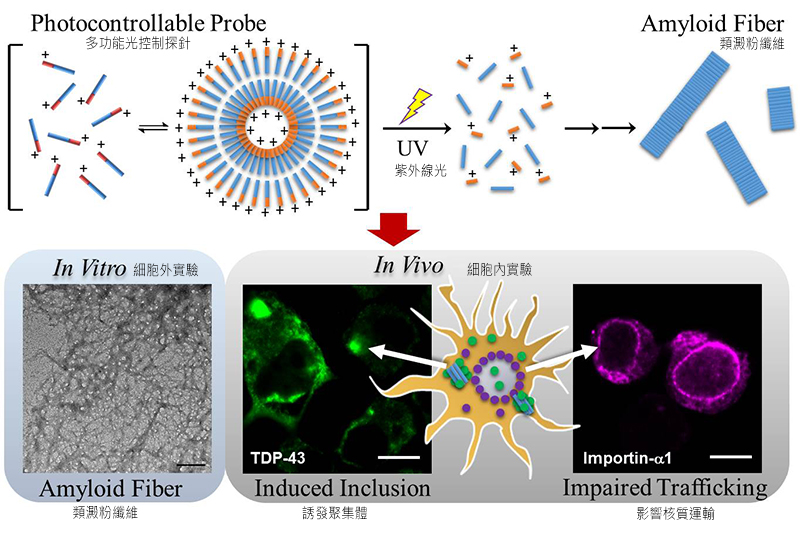
Applying Photocontrollable Probe to Induce Pathological Proteins into Amyloid Fibers in Live Cells

Despite hyperphosphorylated TDP-43 has been confirmed as one of the major components in the inclusion bodies of patients with Amyotrophic Lateral Sclerosis (ALS) or Frontotemporal lobar degeneration (FTLD), the underlying disease mechanism has not yet been fully elucidated. Dr. Joseph Jen-Tse Huang, an associate research fellow at the Institute of Chemistry in Academia Sinica, Dr. Hsien-Ming Lee, an assistant research fellow at the Institute of Chemistry in Academia Sinica, and Dr. Eric Hwang, an associate professor at Department of Biological Science and Technology in National Chiao Tung University, developed a photocontrollable probe to induce TDP-43 aggregates in live cells. This platform enables researchers to spatiotemporally control the formation of the neurotoxic fibrils and directly observe the TDP-43 amyloidogenic process. The research was published in ACS Nano on June 27th, 2017.

Dr. Joseph Jen-Tse Huang was the first to discover the specific TDP-43 C-terminal peptide was able to form amyloid fibers and published his research findings in Journal of American Chemical Society (JACS) in 2010. Later on, he further identified the amyloidogenic core sequence of TDP-43. Based on these findings, Dr. Huang and his collaborators developed a fluorescence-labeled, membrane-permeable, photocontrollable probe which can spatiotemporally controlled the formation of endogenous TDP-43 aggregation in the cytosol and impaired the nuclearcytoplasmic transport without using laborious microinjection. In addition, this probe induced TDP-43 aggregation subsequently triggered neuron degeneration and neurite fragmentation. The observed phenomenon indicated that this probe can be applied as a model platform to mimic the pathological phenotype of neuron in neurodegenerative disease.

Dr. Huang remarked that “Within many currently developed photochemical toolboxes, light would be one of the best triggers to initiate and directly observe the process of TDP-43 amyloidogenesis in vivo. This platform can be widely applied in the studies of aggregation-induced protein mislocalization, amyloid-induced pathogenesis, and protein misfolding in neurodegenerative diseases.” The related results are now under patent application.

In addition, Dr. Huang also collaborated with other principal investigators from Academia Sinica, National Yang-Ming University, and Taipei Veterans General Hospital to extend the use of this platform. In the future, the research team aims to apply the photocontrollable probe both in basic research and clinical science in ALS and other neurodegenerative diseases.

The full article entitled “Photocontrollable Probe Spatiotemporally Induces Neurotoxic Fibrillar Aggregates and Impairs Nucleocytoplasmic Trafficking” can be found at the ACS NANO website at: http://pubs.acs.org/doi/full/10.1021/acsnano.7b01645

Media Contact:
Dr. Joseph Jen-Tse Huang, Associated Research Fellow, Institute of Chemistry, Academia Sinica
Email: jthuang@gate.sinica.edu.tw
(Tel) +886-2-2789-8652


肌萎縮性脊髓側索硬化症(又稱為漸凍人症; ALS)及相關神經元退化性疾病已被發現及研究了多年,但是目前研究與醫療人員對於此類疾病的早期診斷及治療依舊束手無策。雖然近年來高度磷酸化的TDP-43蛋白已被證實為ALS中包涵體的主要成分,此蛋白在致病機轉中所扮演的角色卻仍然不明。本院化學研究所黃人則副研究員,偕同化學所李賢明助研究員,以及交通大學生物科技系黃兆祺副教授,組成研究團隊共同合作,利用化學生物學的技術,建構出可以在活體細胞中誘發TDP-43蛋白異常聚集的光控探針。此探針不但可以控制聚集體產生的時間和位置,並可以直接觀察受光誘發的TDP-43蛋白澱粉狀纖維化過程,便於找出致病的機制。這項研究成果於2017年6月27日刊登在《美國化學會奈米》(ACS Nano)。

黃人則博士於十年前開始投入ALS的研究,2010年首度將所發現的TDP-43蛋白致類澱粉狀纖維的胜肽序列發表於《美國化學會會誌》(JACS),並隨後找出其最短形成蛋白聚集體的致病核心序列。此次由中研院以及合作的研究團隊於之前的研究基礎上,建立一個能夠在活體細胞與組織中,利用光遙控誘導方式,專一地控制活體細胞內TDP-43類澱粉狀纖維形成過程的新平台。此一具有螢光標記、並且可穿越細胞膜的探針,不需使用繁複費力的顯微注射方式,即可在特定時間及空間上控制內生性TDP-43蛋白在細胞質內形成聚集體,並藉此影響核質運輸過程。此種由光控引發的TDP-43蛋白聚集體,亦會造成神經元的退化及死亡,因此可模擬神經細胞在退化疾病中的狀態。

黃人則博士表示,在目前已發展的化學生物工具中,光照是最佳體外遙控誘導方式之一。此項研究成果應用了新穎技術,以光遙控特異性致病蛋白之聚集,藉此模擬漸凍人致病的進程,用以探索神經退化性疾病之致病機制。相關的研究成果,正在申請專利,也希望能吸引國內外學界及業界對於此一領域之重視。

除此之外,該項研究技術也應用在由黃人則博士主持的中研院主題研究計畫之中,此計畫結合了中研院、陽明大學的基礎科學研究員,及台北榮總的臨床醫師。未來期望可應用此光控探針於漸凍人症及其他神經退化性疾病在基礎科學及臨床應用上之相關研究。


參考網站:
ACS Nano (ACS Publications)

新聞聯繫人:
黃人則博士,中央研究院化學研究所副研究員 
jthuang@gate.sinica.edu.tw
   
(Tel) +886-2-2789-8652