Institute of Chemistry, Academia Sinica – Research
Directions
The research thrusts of the Institute are currently grouped along three major directions: materials chemistry, chemical synthesis and catalysis, and chemical biology. The current topics of materials sector include organic electroluminescent materials and devices, organic field-effect transistor materials and devices, photovoltaic materials and devices. The chemical catalysis and synthesis sector is focusing on the development of new synthetic methodology, drug discovery, carbohydrate chemistry, and the development of new catalytic systems for the generation of renewal energies and green fuels. The chemical biology program has made important advances in the delineation of bio-macromolecular structures and the development of new analytical platforms for disease detection and diagnosis.
Materials Chemistry: Organic Electronic and Optoelectronic Materialsy
Applications of organic optoelectronic materials and molecular engineering of nanomaterials are two major research directions under the materials division. Noticeable results include developments of blue fluorescent molecular materials for high performance organic light-emitting diodes, rational design of field-effective organic memory devices based on pentacene and gold nanoparticles, the very first stable organic thin film transistor based on single crystal of hexacene, rare single-walled metal–organic nanotube (MONT) with a large exterior wall diameter, the applications of metal-organic framework as optoelectronic materials, and a number of high performance materials for efficient solar energy harvesting devices such as dye-sensitized solar cells, perovskite solar cells, or organic photovoltaics. Researchers in this sector also develop stimuli-responsive materials, core-shell nanomaterials, and biomaterials. A recent report shows that a cell membrane–mimicking conducting polymer is capable to integrate biochemical and electrical stimulation to promote neural cellular behavior with great enhancement of neurite outgrowth on this conducting polymer.
Chemical Catalysis and Synthesis: Green Catalysis and Synthetic Methodology
In response to the increasingly demands of sustainable fuel and green synthetic technology, researchers in the organic synthesis and chemical catalysis divisions have strived to advance the development of cutting-edge technology for chemical transformations. The synthetic chemistry division of this sector focuses on the advances of synthetic methodology and drug discovery. The research topics under catalysis division is reconciling to catalysis relating to renewable energy. Major research directions in this sector include: (1) synthetic methodology: silyl ethers for hydroxy- directed nucleophilic acyl alkylation, microwave-assisted carbohydrate synthesis, smart fluorescent probes for bioorthogonal sugar labeling; (2) coordination chemistry: approaching unconventional catalysis via amino-NHC and carbodicarbene, unconventional porphyrin complexes for small molecule activations, engineering cytochrome P450 BM3 and alkane hydroxylase (AlkB) for alkane oxidations; (3) renewable energy catalysis: catalytic hydrogen evolution and mechanistic studies, encapsulated tricopper cluster for methane to methanol conversion, and novel catalysts for valorization of lignocellulosic biomass feedstocks.
Chemical Biology: New Material and Method towards Sustainable Health
Chemical biology division focus on the development of new material and methodology to explore the structure and function of macromolecules associated with cellular function or human diseases. The research activities are directed to unravel the underlying pathological mechanism and to derive new diagnostic and therapeutic strategies. Research topics in this division cover (1) development of smart biomaterials based on novel molecular principles; (2) chemical probe and advanced techniques in bio-imaging and structural biology; (3) drug discovery in cancer, infectious and neurodegenerative diseases; (4) development of structural biology techniques for infectious diseases, and (5) development of advanced proteomics strategies for biomarker discovery. The major achievements from the chemical biology group include the establishment of multiplexed quantitative strategy for membrane proteomics and post-translational modification for delineating disease mechanism and mining therapeutic targets discovery of amyloid fibrils induced from the TDP-43 in the Amyotrophic Lateral Sclerosis (ALS), and development of a photocontrollable probe to induce TDP-43 aggregates in live cells, mapping of the RNA exit channel on transcribing RNA polymerase II by FRET analysis, development of nano velcro chip to capture circulating tumor cells for liquid biopsy, construction of a near-infrared- activatable enzyme platform using an up-conversion nanoparticle to remotely trigger intracellular signal transduction.
醣啟動了調控活化B細胞存亡之樞紐
Temporal regulation of Lsp1 O-GlcNAcylation and phosphorylation during apoptosis of activated B cells
Nat Commun. 2016, 7, 12526.
Wu JL, Wu HY, Tsai DY, Chiang MF, Chen YJ, Gao S, Lin CC, Lin CH, Khoo KH, Chen YJ, Lin KI
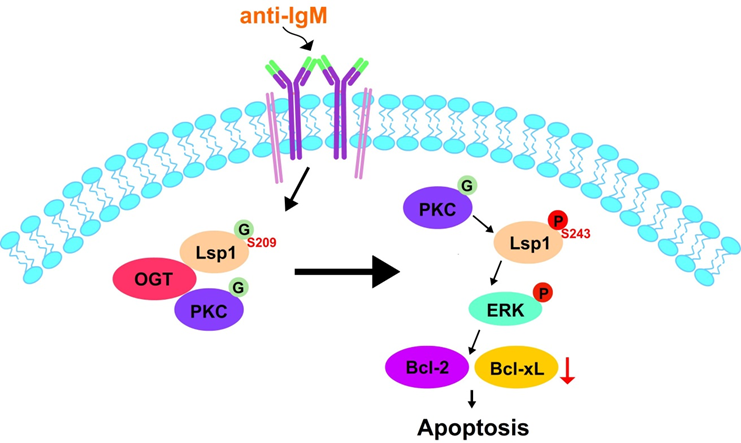
O連結乙醯葡萄氨糖修飾是細胞中的一種後轉錄調控修飾作用,在細胞中此種修飾是經由OGT酵素在蛋白質的絲氨酸和蘇氨酸進行催化完成,另一個酵素OGA則負責將此修飾移除。由於此種修飾是發生在絲氨酸和蘇氨酸上,其在細胞中所參與的許多作用被認為是藉由影響磷酸化修飾來達成。磷酸化蛋白質體和O 連結乙醯葡萄氨糖修飾之同時分析,我們發現高達313個磷酸化點位受到乙醯葡萄氨糖之影響, 其中,Lsp1 蛋白會被 O 連結乙醯葡萄氨糖修飾在絲氨酸 209 位點上。並進而啟動絲氨酸 243 位點的磷酸化透過 Lsp1 蛋白不同的後轉譯修飾突變進行功能性分析時,我們觀察到 Lsp1 蛋白的 O 連結乙醯葡萄氨糖修飾和絲氨酸 243 位點的磷酸化會調控B 細胞的細胞凋亡作用之重要機制,實驗結果發現Lsp1 蛋白的 O 連結乙醯葡萄氨糖修飾是藉由增加 Lsp1 蛋白和負責絲氨酸 243 位點的磷酸化之激酶,PKC-β1 的接合量來達成促進下游和細胞凋亡相關的訊息傳遞體之活化,及降低BCL-2 和 BCL-xL 的表現來達成促進細胞凋亡的作用。綜合上述,我們的實驗結果闡述了蛋白 O 連結乙醯葡萄氨糖修飾和磷酸化修飾之間的動態交互作用決定了 B 細胞受受體接合而活化後的細胞凋亡命運。
Crosslinking of B-cell receptor (BCR) sets off an apoptosis programme, but the underlying pathways remain obscure. Here we decipher the molecular mechanisms bridging B-cell activation and apoptosis mediated by post-translational modification (PTM). We find that O-GlcNAcase inhibition enhances B-cell activation and apoptosis induced by BCR crosslinking. This proteome-scale analysis of the functional interplay between protein O-GlcNAcylation and phosphorylation in stimulated mouse primary B cells identifies 313 O-GlcNAcylation-dependent phosphosites on 224 phosphoproteins. Among these phosphoproteins, temporal regulation of the O-GlcNAcylation and phosphorylation of lymphocyte-specific protein-1 (Lsp1) is a key switch that triggers apoptosis in activated B cells. O-GlcNAcylation at S209 of Lsp1 is a prerequisite for the recruitment of its kinase, PKC-β1, to induce S243 phosphorylation, leading to ERK activation and downregulation of BCL-2 and BCL-xL. Thus, we demonstrate the critical PTM interplay of Lsp1 that transmits signals for initiating apoptosis after BCR ligation.