
Institute of Chemistry, Academia Sinica – Research
Directions
The research thrusts of the Institute are currently grouped along three major directions: materials chemistry, chemical synthesis and catalysis, and chemical biology. The current topics of materials sector include organic electroluminescent materials and devices, organic field-effect transistor materials and devices, photovoltaic materials and devices. The chemical catalysis and synthesis sector is focusing on the development of new synthetic methodology, drug discovery, carbohydrate chemistry, and the development of new catalytic systems for the generation of renewal energies and green fuels. The chemical biology program has made important advances in the delineation of bio-macromolecular structures and the development of new analytical platforms for disease detection and diagnosis.
Materials Chemistry: Organic Electronic and Optoelectronic Materialsy
Applications of organic optoelectronic materials and molecular engineering of nanomaterials are two major research directions under the materials division. Noticeable results include developments of blue fluorescent molecular materials for high performance organic light-emitting diodes, rational design of field-effective organic memory devices based on pentacene and gold nanoparticles, the very first stable organic thin film transistor based on single crystal of hexacene, rare single-walled metal–organic nanotube (MONT) with a large exterior wall diameter, the applications of metal-organic framework as optoelectronic materials, and a number of high performance materials for efficient solar energy harvesting devices such as dye-sensitized solar cells, perovskite solar cells, or organic photovoltaics. Researchers in this sector also develop stimuli-responsive materials, core-shell nanomaterials, and biomaterials. A recent report shows that a cell membrane–mimicking conducting polymer is capable to integrate biochemical and electrical stimulation to promote neural cellular behavior with great enhancement of neurite outgrowth on this conducting polymer.
Chemical Catalysis and Synthesis: Green Catalysis and Synthetic Methodology
In response to the increasingly demands of sustainable fuel and green synthetic technology, researchers in the organic synthesis and chemical catalysis divisions have strived to advance the development of cutting-edge technology for chemical transformations. The synthetic chemistry division of this sector focuses on the advances of synthetic methodology and drug discovery. The research topics under catalysis division is reconciling to catalysis relating to renewable energy. Major research directions in this sector include: (1) synthetic methodology: silyl ethers for hydroxy- directed nucleophilic acyl alkylation, microwave-assisted carbohydrate synthesis, smart fluorescent probes for bioorthogonal sugar labeling; (2) coordination chemistry: approaching unconventional catalysis via amino-NHC and carbodicarbene, unconventional porphyrin complexes for small molecule activations, engineering cytochrome P450 BM3 and alkane hydroxylase (AlkB) for alkane oxidations; (3) renewable energy catalysis: catalytic hydrogen evolution and mechanistic studies, encapsulated tricopper cluster for methane to methanol conversion, and novel catalysts for valorization of lignocellulosic biomass feedstocks.
Chemical Biology: New Material and Method towards Sustainable Health
Chemical biology division focus on the development of new material and methodology to explore the structure and function of macromolecules associated with cellular function or human diseases. The research activities are directed to unravel the underlying pathological mechanism and to derive new diagnostic and therapeutic strategies. Research topics in this division cover (1) development of smart biomaterials based on novel molecular principles; (2) chemical probe and advanced techniques in bio-imaging and structural biology; (3) drug discovery in cancer, infectious and neurodegenerative diseases; (4) development of structural biology techniques for infectious diseases, and (5) development of advanced proteomics strategies for biomarker discovery. The major achievements from the chemical biology group include the establishment of multiplexed quantitative strategy for membrane proteomics and post-translational modification for delineating disease mechanism and mining therapeutic targets discovery of amyloid fibrils induced from the TDP-43 in the Amyotrophic Lateral Sclerosis (ALS), and development of a photocontrollable probe to induce TDP-43 aggregates in live cells, mapping of the RNA exit channel on transcribing RNA polymerase II by FRET analysis, development of nano velcro chip to capture circulating tumor cells for liquid biopsy, construction of a near-infrared- activatable enzyme platform using an up-conversion nanoparticle to remotely trigger intracellular signal transduction.
開發新穎晶片整合質譜技術進行單細胞蛋白質體分析
Streamlined Single-cell Proteomics by an Integrated Microfluidic Chip and Data-independent Acquisition Mass SpectrometryNature Communications 2022, 13, 37.
S. T. Gebreyesusⴕ, A. A. Siyalⴕ, R. B. Kitata, E. S.-W. Chen, B. Enkhbayar, T. Angata, K.-I Lin, Y.-J. Chen* and H.-L. Tu*
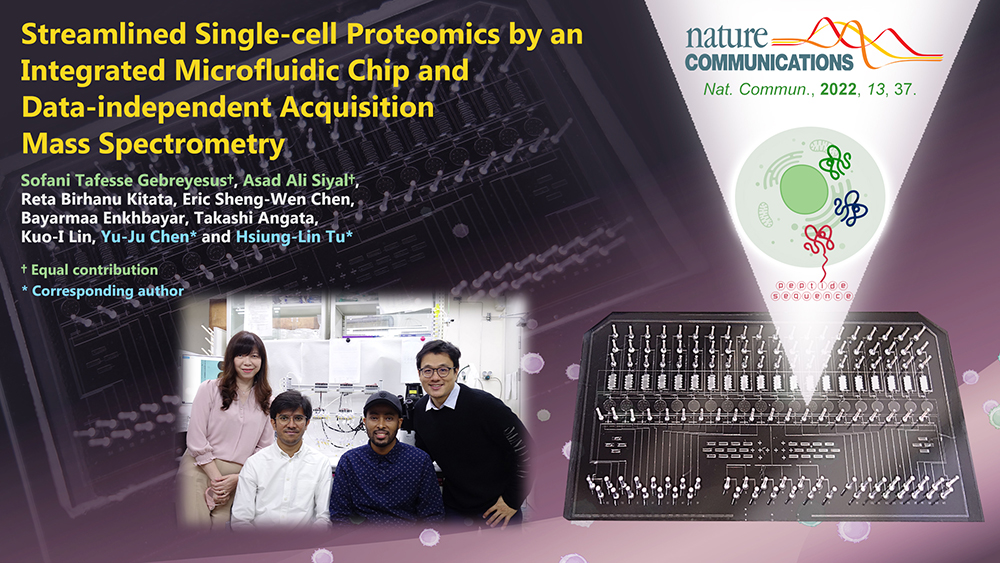
Single-cell proteomics (SCP) can reveal cellular phenotypic heterogeneity and cell-specific functional networks underlying biological processes. Yet its development is relatively limited until recent years. To improve the sensitivity and proteome depth of SCP, a team led by Dr. Hsiung-Lin Tu and Dr. Yu-Ju Chen at Institute of Chemistry recently reported a highly streamlined workflow, which combines microfluidic chips for all-in-one proteomic sample preparation and data-independent acquisition (DIA) mass spectrometry (MS) for proteomic analysis down to the single-cell level. The proteomics chips enable multiplexed and automated cell isolation/counting/imaging and sample processing in a single device. Combining with DIA-MS using project-specific mass spectral libraries, this strategy profiles on average ~1,500 protein groups across 20 single mammalian cells. Applying the chip-DIA workflow to profile the proteomes of adherent and non-adherent malignant cells, the method demonstrates a dynamic range of 5 orders of magnitude with good reproducibility and < 16% missing values between runs. Taken together, the chip-DIA workflow offers all-in-one cell characterization, analytical sensitivity and robustness, and the option to add additional functionalities in the future, thus providing a basis for advanced single-cell proteomics applications.
This study is supported by Academia Sinica and Ministry of Science and Technology in Taiwan. Two Ph.D. students in the TIGP program, Mr. Sofani T. Gebreyesus and Mr. Asad A. Siyal, share the co-first authorship in this study. The corresponding authors include Dr. Hsiung-Lin Tu and Dr. Yu-Ju Chen. Additional collaborators include Dr. Kuo-I Lin and Dr. Takashi Angata from the Genomics Research Center and Institute of Biological Chemistry in Academia Sinica. The full article entitled “Streamlined single-cell proteomics by an integrated microfluidic chip and data-independent acquisition mass spectrometry” is available at the Nature Communications website: https://www.nature.com/articles/s41467-021-27778-4.
單細胞蛋白質體學能解析細胞層級之表型與訊息路徑的差異性。相較於基因體學與轉錄體學,蛋白質體學和細胞執行功能與藥物治療有更直接關聯,然而其相關之技術發展卻相對受限。為了突破分析靈敏度與可靠性,本所涂熊林與陳玉如團隊近期開發了一站式蛋白體製備工作站。其包含前端客製微流晶片與後端高解析質譜分析。此工作站可直接進行細胞抓取、計數與影像擷取,進而顯著改善單細胞製備效率、減少樣品損失與增加重複性。搭配團隊開發的數據依賴擷取質譜儀,此平台可從單細胞鑑定約1500種蛋白質且具定量優勢,並可透過後續分析將其置於訊息網路進行相關的研究探討。研究團隊正著手積極開發下一世代晶片,期望能將此技術用來解決重要的生物問題,亦預期此平台將有助於揭示在不同生理和病理中單一細胞調控的機理。
此研究由本院以及科技部支持。共同第一作者為涂熊林實驗室博士生宋方寧(Sofani Gebreyesus)與陳玉如實驗室博士生史昂德(Asad Siyal);通訊作者為涂熊林助研究員以及陳玉如特聘研究員。研究團隊還包括本院基因體中心林國儀研究員與生物化學研究所安形高志副研究員。期刊論文標題為 “Streamlined single-cell proteomics by an integrated microfluidic chip and data-independent acquisition mass spectrometry”,可於以下連結閱讀: https://www.nature.com/articles/s41467-021-27778-4。
