
Institute of Chemistry, Academia Sinica – Research
以 PROTAC 分子清除腦內亨丁頓蛋白聚集物:治療神經退化疾病的新策略
Brain-Penetrant Molecule Removes Toxic Huntingtin Aggregates in MiceJ. Am. Chem. Soc. 2026, 148, 8107
Po-Chao Lu, Yung-An Huang, Niaz Wali, Mei-Chun Tseng, Ruei-Yu He, Yijuang Chern, Tzu-Tang Wei,
Jiun-Jie Shie,* and Joseph Jen-Tse Huang*
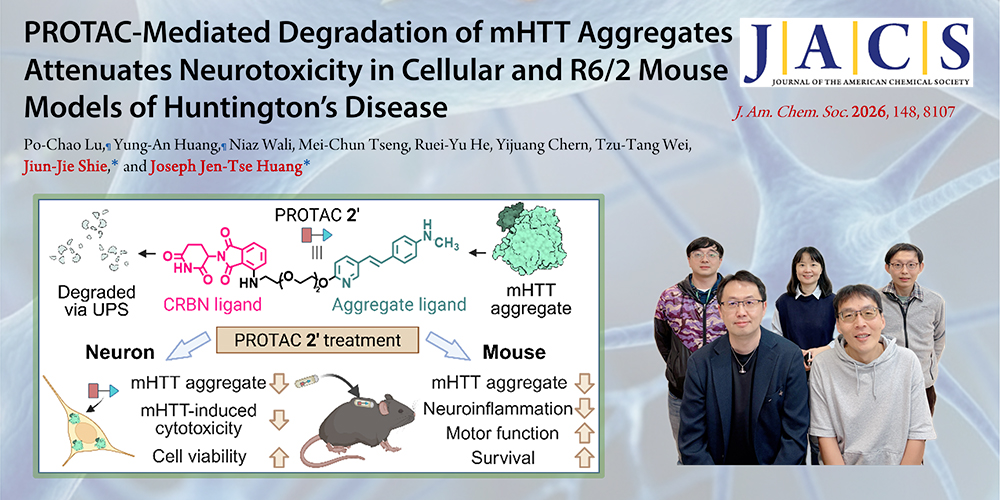
亨丁頓氏舞蹈症(Huntington’s disease)是一種神經退化性疾病,其成因是 HTT 基因發生突變,產生異常的亨丁頓蛋白(mutant huntingtin)。這種異常蛋白會在腦細胞中累積並形成具有毒性的蛋白聚集物,逐漸影響神經元的正常功能。目前的治療方式主要著重於症狀緩解,針對疾病進程的有效治療仍有待進一步突破。
中央研究院化學研究所黃人則研究員所領導的研究團隊,開發出一種新的分子策略來治療亨丁頓氏舞蹈症。這種分子屬於 PROTAC(proteolysis-targeting chimera,蛋白質降解嵌合分子) 類型,能夠將有害蛋白引導至細胞自身的蛋白質降解系統。值得注意的是,這項研究開發的 PROTAC 能夠成功穿越血腦障壁並進入腦部組織。進入腦部後,該分子可選擇性辨識並清除具有毒性的亨丁頓蛋白聚集物,並將其送往細胞的蛋白酶體系統進行分解。研究結果顯示,此 PROTAC 能在神經細胞與亨丁頓氏舞蹈症小鼠模型的腦部中有效降低亨丁頓蛋白聚集物。經治療的小鼠表現出運動能力改善、神經發炎降低,以及存活時間延長。這些結果顯示,透過 PROTAC 選擇性降解蛋白聚集物,可能為亨丁頓氏舞蹈症提供一種新的治療方法。
本研究的共同第一作者為中央研究院國際研究生學程博士生盧柏超與中研院博士後研究員黃永安博士。PROTAC 分子的合成由中研院化學所謝俊結副研究員實驗室合作完成。本研究由中央研究院與國家科學及技術委員會(NSTC)支持,化學研究所的質譜分析核心設施與影像核心設施亦提供重要技術協助。文章已於 2026 年 2 月 19 日發布於《美國化學會誌》(Journal of the American Chemical Society)。
期刊連結:https://pubs.acs.org/doi/10.1021/jacs.5c14078
Huntington’s disease (HD) is a fatal neurodegenerative disorder caused by a mutation in the HTT gene that produces a defective protein known as mutant huntingtin (mHTT). This abnormal protein accumulates in brain cells and forms toxic aggregates that gradually damage neurons. Current treatments can only relieve symptoms and do not slow disease progression.
A research team led by Dr. Jen-Tse Huang at the Institute of Chemistry, Academia Sinica has developed a new molecular strategy to treat HD. The molecule belongs to a class called PROTACs (proteolysis-targeting chimeras), which guide harmful proteins to the cell’s degradation machinery. Importantly, the newly developed PROTAC can cross the blood–brain barrier and reach brain tissue. Once inside the brain, it selectively binds and eliminates toxic mHTT aggregates and directs them to the proteasome system for degradation. The results demonstrate that this PROTAC effectively reduces mHTT aggregates in neuronal cells and in the brains of HD mice. Treatment also improves motor performance, reduces neuroinflammation, and prolongs survival in the animal model. These findings highlight the therapeutic potential of an aggregate-selective PROTAC strategy for the treatment of HD.
The study was co–first authored by Po-Chao Lu, a Ph.D. student in the Academia Sinica–International Graduate Program in Chemical Biology and Molecular Biophysics, and Dr. Yung-An Huang, a postdoctoral researcher in Dr. Huang’s laboratory. The PROTAC molecules were synthesized in collaboration with the laboratory of Dr. Jiun-Jie Shie at the Institute of Chemistry, Academia Sinica. This research was supported by Academia Sinica and the National Science and Technology Council. Core facilities at the Institute of Chemistry, including the Mass Spectrometry Facility and Imaging Facility, also provided technical support. The study was published on February 19, 2026, in the Journal of the American Chemical Society (JACS).
Article link:https://pubs.acs.org/doi/10.1021/jacs.5c14078