
Main Content
:::

Institute of Chemistry, Academia Sinica – Research

Directions

The research thrusts of the Institute are currently grouped along three major directions: materials chemistry, chemical synthesis and catalysis, and chemical biology. The current topics of materials sector include organic electroluminescent materials and devices, organic field-effect transistor materials and devices, photovoltaic materials and devices. The chemical catalysis and synthesis sector is focusing on the development of new synthetic methodology, drug discovery, carbohydrate chemistry, and the development of new catalytic systems for the generation of renewal energies and green fuels. The chemical biology program has made important advances in the delineation of bio-macromolecular structures and the development of new analytical platforms for disease detection and diagnosis.

Materials Chemistry: Organic Electronic and Optoelectronic Materialsy

Applications of organic optoelectronic materials and molecular engineering of nanomaterials are two major research directions under the materials division. Noticeable results include developments of blue fluorescent molecular materials for high performance organic light-emitting diodes, rational design of field-effective organic memory devices based on pentacene and gold nanoparticles, the very first stable organic thin film transistor based on single crystal of hexacene, rare single-walled metal–organic nanotube (MONT) with a large exterior wall diameter, the applications of metal-organic framework as optoelectronic materials, and a number of high performance materials for efficient solar energy harvesting devices such as dye-sensitized solar cells, perovskite solar cells, or organic photovoltaics. Researchers in this sector also develop stimuli-responsive materials, core-shell nanomaterials, and biomaterials. A recent report shows that a cell membrane–mimicking conducting polymer is capable to integrate biochemical and electrical stimulation to promote neural cellular behavior with great enhancement of neurite outgrowth on this conducting polymer.

Chemical Catalysis and Synthesis: Green Catalysis and Synthetic Methodology

In response to the increasingly demands of sustainable fuel and green synthetic technology, researchers in the organic synthesis and chemical catalysis divisions have strived to advance the development of cutting-edge technology for chemical transformations. The synthetic chemistry division of this sector focuses on the advances of synthetic methodology and drug discovery. The research topics under catalysis division is reconciling to catalysis relating to renewable energy. Major research directions in this sector include: (1) synthetic methodology: silyl ethers for hydroxy- directed nucleophilic acyl alkylation, microwave-assisted carbohydrate synthesis, smart fluorescent probes for bioorthogonal sugar labeling; (2) coordination chemistry: approaching unconventional catalysis via amino-NHC and carbodicarbene, unconventional porphyrin complexes for small molecule activations, engineering cytochrome P450 BM3 and alkane hydroxylase (AlkB) for alkane oxidations; (3) renewable energy catalysis: catalytic hydrogen evolution and mechanistic studies, encapsulated tricopper cluster for methane to methanol conversion, and novel catalysts for valorization of lignocellulosic biomass feedstocks.

Chemical Biology: New Material and Method towards Sustainable Health

Chemical biology division focus on the development of new material and methodology to explore the structure and function of macromolecules associated with cellular function or human diseases. The research activities are directed to unravel the underlying pathological mechanism and to derive new diagnostic and therapeutic strategies. Research topics in this division cover (1) development of smart biomaterials based on novel molecular principles; (2) chemical probe and advanced techniques in bio-imaging and structural biology; (3) drug discovery in cancer, infectious and neurodegenerative diseases; (4) development of structural biology techniques for infectious diseases, and (5) development of advanced proteomics strategies for biomarker discovery. The major achievements from the chemical biology group include the establishment of multiplexed quantitative strategy for membrane proteomics and post-translational modification for delineating disease mechanism and mining therapeutic targets discovery of amyloid fibrils induced from the TDP-43 in the Amyotrophic Lateral Sclerosis (ALS), and development of a photocontrollable probe to induce TDP-43 aggregates in live cells, mapping of the RNA exit channel on transcribing RNA polymerase II by FRET analysis, development of nano velcro chip to capture circulating tumor cells for liquid biopsy, construction of a near-infrared- activatable enzyme platform using an up-conversion nanoparticle to remotely trigger intracellular signal transduction.

可黏附單核細胞之多肽微脂體應用腫瘤治療

Monocyte-adhesive peptidyl liposomes for harnessing monocyte homing to tumor tissues

Journal of Controlled Release 2025, 382, 113672
Chia-Yu Chang, Shih-Hsun Huang, Chong-Yan Chen, Cheng-Bang Jian, Ching-Chung Chang, Yu-Yao Chang, Mira Jung, Hsien-Ming Lee*, Bill Cheng*
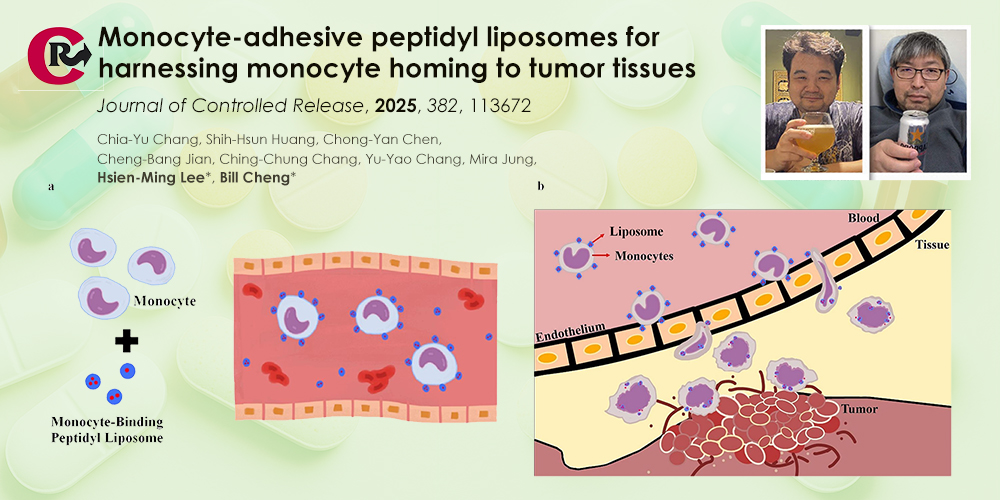
Monocyte-adhesive peptidyl liposomes for harnessing monocyte homing to tumor tissues

In current drug delivery strategies, the efficiency of most carriers still largely depends on their ability to passively infiltrate target tissues. To overcome this limitation, we developed monocyte-adhesive peptidyl liposomes, termed monocyte-mediated drug carriers (MMDCs). These carriers are designed to exploit the innate chemotactic properties of monocytes, which actively home to diseased tissues. MMDCs were shown to effectively hitchhike on circulating monocytes (THP-1 cells) under physiological flow conditions. Their targeting specificity was further demonstrated in a 3D microfluidic culture system consisting of human breast cancer spheroids (MDA-MB-231) embedded in a collagen matrix, overlaid with a human endothelial cell-derived barrier. MMDCs underwent trans-endothelial migration via monocyte hitchhiking and selectively recognized collagen matrices containing MDA-MB-231 cells, but not those embedded with non-cancerous cells. In vitro assays revealed that doxorubicin encapsulated in MMDCs was released into the extracellular environment following phagocytosis of the carriers by THP-1-derived macrophages. In a xenograft mouse model, MMDCs exhibited high tumor-targeting efficiency. By harnessing the homing capability of monocytes, MMDCs significantly improved drug biodistribution at the disease site, thereby enhancing the therapeutic efficacy of the encapsulated agents.

在現行的藥物傳遞策略中,大多數載體的效率仍主要依賴其被動滲透至目標組織的能力。為了克服這一限制,我們開發了具單核白血球黏附性的多肽微脂體。這些多肽微脂體旨在利用單核白血球的先天趨向疾病組織細胞激素特性,主動靶向至病變組織。研究顯示,我們多肽微脂體在生理流動條件下能有效搭載於循環中的單核白血球(THP-1 細胞)上。其靶向特異性進一步在一個三維微流體培養系統中得到驗證。我們多肽微脂體可透過單核球搭載方式穿越內皮層,並選擇性辨識含有 MDA-MB-231 細胞的膠原基質,而選擇性不靶向嵌有非癌細胞的基質。體外試驗顯示,當載有微脂體的單核細胞並不會內吞微脂體,但發炎因子將單核細胞轉換成巨噬細胞後,微脂體被吞噬,而封裝於其中的多柔比星(doxorubicin)可釋放至細胞外環境進行化療。在異種移植小鼠模型中,我們的微脂體展現出高度腫瘤靶向效率。透過利用單核細胞的靶向能力,所承載的微脂體可顯著提升藥物在病灶部位的生物分佈,進而增強所封裝藥物的治療效力。