
Main Content
:::

Institute of Chemistry, Academia Sinica – Research

Directions

The research thrusts of the Institute are currently grouped along three major directions: materials chemistry, chemical synthesis and catalysis, and chemical biology. The current topics of materials sector include organic electroluminescent materials and devices, organic field-effect transistor materials and devices, photovoltaic materials and devices. The chemical catalysis and synthesis sector is focusing on the development of new synthetic methodology, drug discovery, carbohydrate chemistry, and the development of new catalytic systems for the generation of renewal energies and green fuels. The chemical biology program has made important advances in the delineation of bio-macromolecular structures and the development of new analytical platforms for disease detection and diagnosis.

Materials Chemistry: Organic Electronic and Optoelectronic Materialsy

Applications of organic optoelectronic materials and molecular engineering of nanomaterials are two major research directions under the materials division. Noticeable results include developments of blue fluorescent molecular materials for high performance organic light-emitting diodes, rational design of field-effective organic memory devices based on pentacene and gold nanoparticles, the very first stable organic thin film transistor based on single crystal of hexacene, rare single-walled metal–organic nanotube (MONT) with a large exterior wall diameter, the applications of metal-organic framework as optoelectronic materials, and a number of high performance materials for efficient solar energy harvesting devices such as dye-sensitized solar cells, perovskite solar cells, or organic photovoltaics. Researchers in this sector also develop stimuli-responsive materials, core-shell nanomaterials, and biomaterials. A recent report shows that a cell membrane–mimicking conducting polymer is capable to integrate biochemical and electrical stimulation to promote neural cellular behavior with great enhancement of neurite outgrowth on this conducting polymer.

Chemical Catalysis and Synthesis: Green Catalysis and Synthetic Methodology

In response to the increasingly demands of sustainable fuel and green synthetic technology, researchers in the organic synthesis and chemical catalysis divisions have strived to advance the development of cutting-edge technology for chemical transformations. The synthetic chemistry division of this sector focuses on the advances of synthetic methodology and drug discovery. The research topics under catalysis division is reconciling to catalysis relating to renewable energy. Major research directions in this sector include: (1) synthetic methodology: silyl ethers for hydroxy- directed nucleophilic acyl alkylation, microwave-assisted carbohydrate synthesis, smart fluorescent probes for bioorthogonal sugar labeling; (2) coordination chemistry: approaching unconventional catalysis via amino-NHC and carbodicarbene, unconventional porphyrin complexes for small molecule activations, engineering cytochrome P450 BM3 and alkane hydroxylase (AlkB) for alkane oxidations; (3) renewable energy catalysis: catalytic hydrogen evolution and mechanistic studies, encapsulated tricopper cluster for methane to methanol conversion, and novel catalysts for valorization of lignocellulosic biomass feedstocks.

Chemical Biology: New Material and Method towards Sustainable Health

Chemical biology division focus on the development of new material and methodology to explore the structure and function of macromolecules associated with cellular function or human diseases. The research activities are directed to unravel the underlying pathological mechanism and to derive new diagnostic and therapeutic strategies. Research topics in this division cover (1) development of smart biomaterials based on novel molecular principles; (2) chemical probe and advanced techniques in bio-imaging and structural biology; (3) drug discovery in cancer, infectious and neurodegenerative diseases; (4) development of structural biology techniques for infectious diseases, and (5) development of advanced proteomics strategies for biomarker discovery. The major achievements from the chemical biology group include the establishment of multiplexed quantitative strategy for membrane proteomics and post-translational modification for delineating disease mechanism and mining therapeutic targets discovery of amyloid fibrils induced from the TDP-43 in the Amyotrophic Lateral Sclerosis (ALS), and development of a photocontrollable probe to induce TDP-43 aggregates in live cells, mapping of the RNA exit channel on transcribing RNA polymerase II by FRET analysis, development of nano velcro chip to capture circulating tumor cells for liquid biopsy, construction of a near-infrared- activatable enzyme platform using an up-conversion nanoparticle to remotely trigger intracellular signal transduction.

常溫常壓下透過電壓導控進行三銅金屬簇電化學催化有效率與高選擇性地氧化甲烷至甲醇

Voltage-Gated Electrocatalysis of Efficient and Selective Methane Oxidation by Tricopper Clusters under Ambient Conditions

JACS 2022, 144, 9695-9706.
Yi-Fang Tsai, Thiyagarajan Natarajan, Zhi-Han Lin, I-Kuen Tsai, Damodar Janmanchi, Sunney I. Chan*, Steve S.-F. Yu*

選擇性地將甲烷氧化為甲醇是困難的化學,此研究中,我們發展一個策略,將細菌膜蛋白與仿生觸媒等三種三銅金屬簇分子催化劑塗佈在電化學電池的陰極表面上,在氧分子與甲烷同時存在並超過特定的電壓運作下,於電解水溶液中,利用陰極表面將電子注入三銅活性中心後,可有效能地進行氧原子的轉移至甲烷,催化轉換成甲醇。此成果呈現迄今最佳的電化學轉化效能,常溫常壓下,單一三銅活性中心,每分鐘產製四十個甲醇分子,十二小時轉化輸出效率大於三萬個分子以上。此技術研發,可運用於綠電儲能的催化轉化,具現地進行氣液直接轉換成甲醇等液態醇基綠能分子的優勢。

A strategy has been developed for efficient electrocatalysis of selective methane oxidation under ambient temperatures and pressures. Activation of tricopper catalysts immobilized on the surface of a carbon electrode in the presence of dioxygen (O2) and methane above a threshold cathodic potential can initiate the O2 chemistry for O-atom transfer to methane. The catalytic turnover is completed by facile electron injections into the tricopper catalysts from the electrode. This technology leads to dramatic enhancements in performance of the catalysts toward methane oxidation. Unprecedented turnover frequencies (>40 min−1) and high product throughputs (turnover numbers >30 000 in 12 h) are achieved for this challenging chemical transformation in water under ambient conditions. The catalysts are air tolerant and do not support O2 activation unless voltage-gated. The technology is green and suitable for on-site direct conversion of methane into methanol.
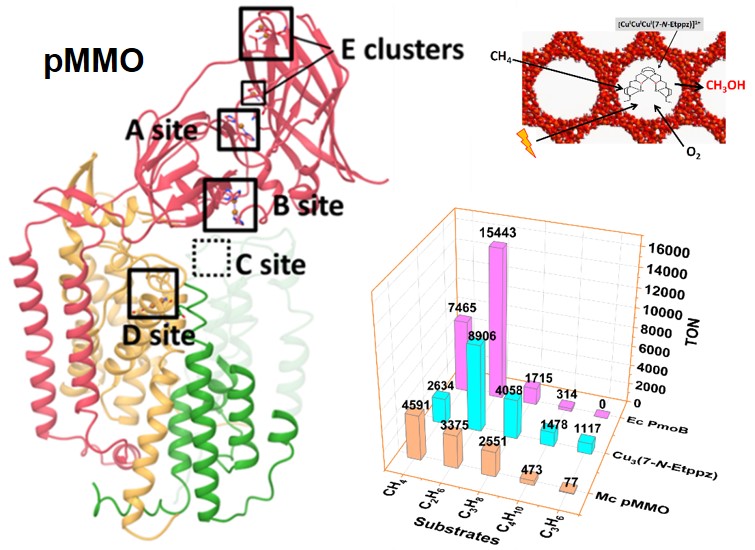
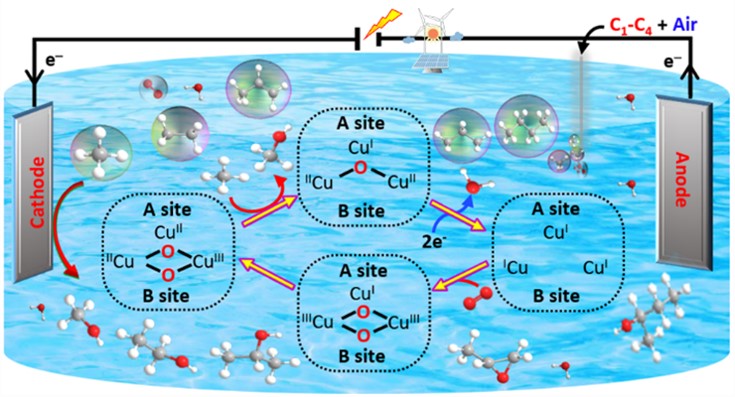
Catalytic oxidation of methane, other light alkanes. and propene is mediated by electrodes modified by the particulate methane monooxygenase (pMMO) and its recombinant protein and bioinspired catalysts.

Catalytic oxidation of methane, other light alkanes. and propene is mediated by electrodes modified by the particulate methane monooxygenase (pMMO) and its recombinant protein and bioinspired catalysts.