
Institute of Chemistry, Academia Sinica – Research
Directions
The research thrusts of the Institute are currently grouped along three major directions: materials chemistry, chemical synthesis and catalysis, and chemical biology. The current topics of materials sector include organic electroluminescent materials and devices, organic field-effect transistor materials and devices, photovoltaic materials and devices. The chemical catalysis and synthesis sector is focusing on the development of new synthetic methodology, drug discovery, carbohydrate chemistry, and the development of new catalytic systems for the generation of renewal energies and green fuels. The chemical biology program has made important advances in the delineation of bio-macromolecular structures and the development of new analytical platforms for disease detection and diagnosis.
Materials Chemistry: Organic Electronic and Optoelectronic Materialsy
Applications of organic optoelectronic materials and molecular engineering of nanomaterials are two major research directions under the materials division. Noticeable results include developments of blue fluorescent molecular materials for high performance organic light-emitting diodes, rational design of field-effective organic memory devices based on pentacene and gold nanoparticles, the very first stable organic thin film transistor based on single crystal of hexacene, rare single-walled metal–organic nanotube (MONT) with a large exterior wall diameter, the applications of metal-organic framework as optoelectronic materials, and a number of high performance materials for efficient solar energy harvesting devices such as dye-sensitized solar cells, perovskite solar cells, or organic photovoltaics. Researchers in this sector also develop stimuli-responsive materials, core-shell nanomaterials, and biomaterials. A recent report shows that a cell membrane–mimicking conducting polymer is capable to integrate biochemical and electrical stimulation to promote neural cellular behavior with great enhancement of neurite outgrowth on this conducting polymer.
Chemical Catalysis and Synthesis: Green Catalysis and Synthetic Methodology
In response to the increasingly demands of sustainable fuel and green synthetic technology, researchers in the organic synthesis and chemical catalysis divisions have strived to advance the development of cutting-edge technology for chemical transformations. The synthetic chemistry division of this sector focuses on the advances of synthetic methodology and drug discovery. The research topics under catalysis division is reconciling to catalysis relating to renewable energy. Major research directions in this sector include: (1) synthetic methodology: silyl ethers for hydroxy- directed nucleophilic acyl alkylation, microwave-assisted carbohydrate synthesis, smart fluorescent probes for bioorthogonal sugar labeling; (2) coordination chemistry: approaching unconventional catalysis via amino-NHC and carbodicarbene, unconventional porphyrin complexes for small molecule activations, engineering cytochrome P450 BM3 and alkane hydroxylase (AlkB) for alkane oxidations; (3) renewable energy catalysis: catalytic hydrogen evolution and mechanistic studies, encapsulated tricopper cluster for methane to methanol conversion, and novel catalysts for valorization of lignocellulosic biomass feedstocks.
Chemical Biology: New Material and Method towards Sustainable Health
Chemical biology division focus on the development of new material and methodology to explore the structure and function of macromolecules associated with cellular function or human diseases. The research activities are directed to unravel the underlying pathological mechanism and to derive new diagnostic and therapeutic strategies. Research topics in this division cover (1) development of smart biomaterials based on novel molecular principles; (2) chemical probe and advanced techniques in bio-imaging and structural biology; (3) drug discovery in cancer, infectious and neurodegenerative diseases; (4) development of structural biology techniques for infectious diseases, and (5) development of advanced proteomics strategies for biomarker discovery. The major achievements from the chemical biology group include the establishment of multiplexed quantitative strategy for membrane proteomics and post-translational modification for delineating disease mechanism and mining therapeutic targets discovery of amyloid fibrils induced from the TDP-43 in the Amyotrophic Lateral Sclerosis (ALS), and development of a photocontrollable probe to induce TDP-43 aggregates in live cells, mapping of the RNA exit channel on transcribing RNA polymerase II by FRET analysis, development of nano velcro chip to capture circulating tumor cells for liquid biopsy, construction of a near-infrared- activatable enzyme platform using an up-conversion nanoparticle to remotely trigger intracellular signal transduction.
雙卡本鉗形配位基及其對多金屬構型的配位行為
A Bis-(carbone) Pincer Ligand and Its Coordinative Behavior toward Multi-Metallic ConfigurationsAngew. Chem. Int. Ed. 2022, 61, e202201884
Bamlaku Semagne Aweke, Cheng-Han Yu, Minna Zhi, Wen-Ching Chen, Glenn P. A. Yap, Lili Zhao*, Tiow-Gan Ong*
Carbones are divalent carbon(0)species that contain two lone pairs of electrons. Herein, we have prepared the first known stable and isolable free bis-(carbone) pincer framework with a well-defined solid-state structure. This bis-(carbone)ligand is an effective scaffold for forming monometallic(Ni and Pd) and trinuclear heterometallic complexes with Au-Pd-Au, Au-Ni-Au, and Cu-Ni-Cu configurations. Sophisticated quantum-theoretical analyses found that the metal-metal interactions are too weak to play a significant role in upholding these multi-metallic configurations; rather, the four lone pairs of electrons within the bis-(carbone) framework are the main contributors to the stability of the complexes.
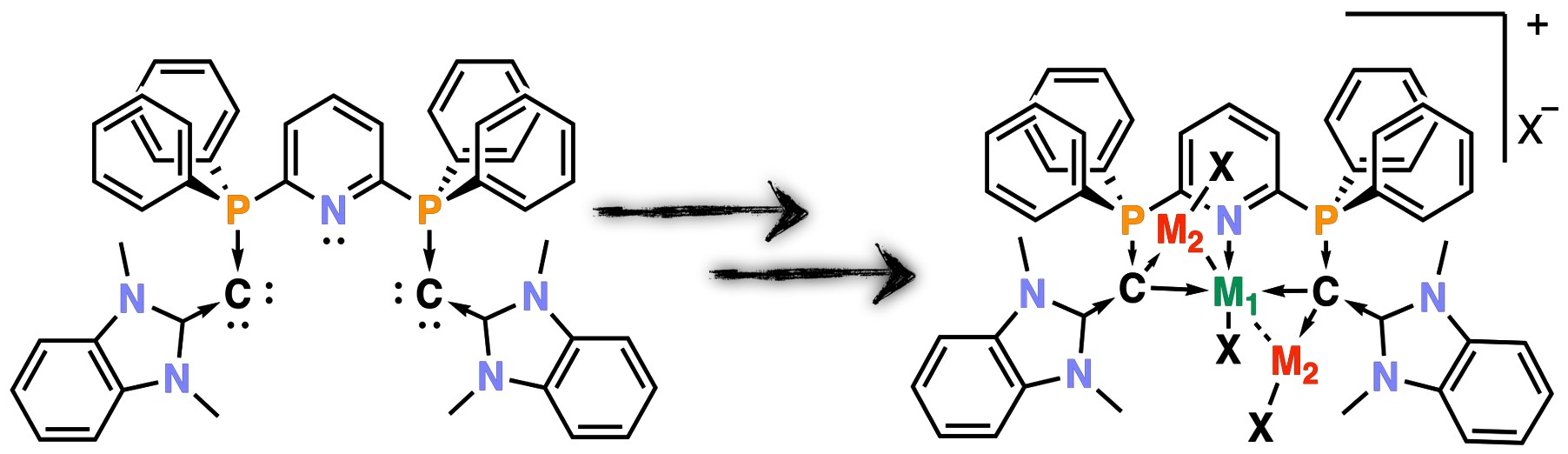
卡本是含有兩對孤對電子的二配位碳零價化合物。在本研究中,我們製備了第一個穩定且可分離並具有明確晶體結構的游離雙卡本鉗形骨架。這種雙卡本配位基是形成單金屬(Ni 和 Pd)和三核異金屬 Au-Pd-Au、Au-Ni-Au 和 Cu-Ni-Cu 構型錯合物的有效支架。先進的量子理論分析發現金屬-金屬相互作用力太弱,無法在維持這些多金屬配置上發揮重要作用;相反的,雙卡本骨架內的四對孤對電子是多金屬錯合物穩定性的主要貢獻者。
