
Institute of Chemistry, Academia Sinica – Research
RNA 聚合酶 III 延伸複合體中 Rpc34 翼狀螺旋結構的動態定位:維持複合體穩定性並可能促進轉錄再起始
Dynamic positioning of Rpc34 winged helix in RNA polymerase III elongation complex for its stability with implications for reinitiationPNAS 2026, 123(27), e2601775123
Jheng-Syong Wu, Yu-Chun Lin, Yi-Yu Wei, Hsin-Hung Lin, Yang-Chih Liu, Jen-Wei Chang, I-Ping Tu*, Hung-Ta Chen*, Wei-Hau Chang*
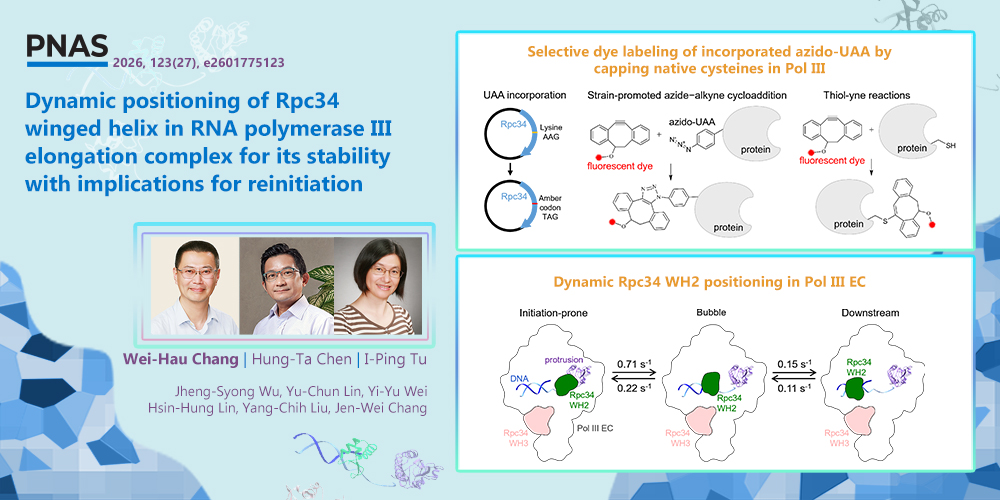
RNA 聚合酶 III (Pol III) 是真核細胞內不可或缺的分子機器,負責製造蛋白質合成所需的重要 RNA,以及維持細胞正常生長與運作的 RNA. 然而,其中負責調控功能的 Rpc34 蛋白的翼狀域因持續動態移動,難以用冷凍電子鏡三維重建來定位。中央研究院化學所章為皓副研究員、分生所陳宏達副研究員及統計所杜憶萍研究員組成跨所研究團隊,利用 Bertozzi 點擊化學開發高專一性的生物正交定點標記技術,再以單分子螢光共振能轉移成像技術成功即時追蹤 Rpc34 的動態變化。研究發現,Rpc34 翼狀域會在三個特定位置之間切換,如同可調節的支架,一方面協助穩定 RNA 聚合酶 III 的運作,另一方面預備 RNA 聚合酶 III 進行下一輪 RNA 的合成。這項研究不僅揭開 RNA 聚合酶 III 的重要運作機制,也建立了一套可廣泛應用於大型動態生物分子機器研究的新技術平台。研究成果已發表於《美國國家科學院院刊》(PNAS),並獲中央研究院及國科會 (NSTC) 支持。
RNA polymerase III (Pol III) is a vital molecular machine that every eukaryotic cell uses to produce short but essential RNA molecules needed to make proteins and sustain life. However, one of its key domain in Rpc34 subunit, has evaded detection by conventional structural biology methods including cryo-EM because of its being highly mobile. A research team led by Dr. Wei-Hau Chang (Institute of Chemistry), Dr. Hung-Ta Chen (Institute of Molecular Biology), together with Dr. I-Ping Tu (Institute of Statistical Science) at Academia Sinica innovated a new labeling method based on Bertozzi click chemistry and developed efficient and accurate FRET data analysis to allow them to track this tiny Rpc34 winged-helix domain in real time, one molecule at a time. They discovered that this domain moves among three preferred positions, helping keeping the transcription machinery stable and prime the machine ready for quickly start a new round of RNA production. Beyond deepening our understanding of how Pol III works, the new labeling technique provides a powerful tool for studying the dynamics of functional parts in many large biological machines. The study was published in PNAS and was supported by Academia Sinica and the National Science and Technology Council (NSTC).