Institute of Chemistry, Academia Sinica – Research
Directions
The research thrusts of the Institute are currently grouped along three major directions: materials chemistry, chemical synthesis and catalysis, and chemical biology. The current topics of materials sector include organic electroluminescent materials and devices, organic field-effect transistor materials and devices, photovoltaic materials and devices. The chemical catalysis and synthesis sector is focusing on the development of new synthetic methodology, drug discovery, carbohydrate chemistry, and the development of new catalytic systems for the generation of renewal energies and green fuels. The chemical biology program has made important advances in the delineation of bio-macromolecular structures and the development of new analytical platforms for disease detection and diagnosis.
Materials Chemistry: Organic Electronic and Optoelectronic Materialsy
Applications of organic optoelectronic materials and molecular engineering of nanomaterials are two major research directions under the materials division. Noticeable results include developments of blue fluorescent molecular materials for high performance organic light-emitting diodes, rational design of field-effective organic memory devices based on pentacene and gold nanoparticles, the very first stable organic thin film transistor based on single crystal of hexacene, rare single-walled metal–organic nanotube (MONT) with a large exterior wall diameter, the applications of metal-organic framework as optoelectronic materials, and a number of high performance materials for efficient solar energy harvesting devices such as dye-sensitized solar cells, perovskite solar cells, or organic photovoltaics. Researchers in this sector also develop stimuli-responsive materials, core-shell nanomaterials, and biomaterials. A recent report shows that a cell membrane–mimicking conducting polymer is capable to integrate biochemical and electrical stimulation to promote neural cellular behavior with great enhancement of neurite outgrowth on this conducting polymer.
Chemical Catalysis and Synthesis: Green Catalysis and Synthetic Methodology
In response to the increasingly demands of sustainable fuel and green synthetic technology, researchers in the organic synthesis and chemical catalysis divisions have strived to advance the development of cutting-edge technology for chemical transformations. The synthetic chemistry division of this sector focuses on the advances of synthetic methodology and drug discovery. The research topics under catalysis division is reconciling to catalysis relating to renewable energy. Major research directions in this sector include: (1) synthetic methodology: silyl ethers for hydroxy- directed nucleophilic acyl alkylation, microwave-assisted carbohydrate synthesis, smart fluorescent probes for bioorthogonal sugar labeling; (2) coordination chemistry: approaching unconventional catalysis via amino-NHC and carbodicarbene, unconventional porphyrin complexes for small molecule activations, engineering cytochrome P450 BM3 and alkane hydroxylase (AlkB) for alkane oxidations; (3) renewable energy catalysis: catalytic hydrogen evolution and mechanistic studies, encapsulated tricopper cluster for methane to methanol conversion, and novel catalysts for valorization of lignocellulosic biomass feedstocks.
Chemical Biology: New Material and Method towards Sustainable Health
Chemical biology division focus on the development of new material and methodology to explore the structure and function of macromolecules associated with cellular function or human diseases. The research activities are directed to unravel the underlying pathological mechanism and to derive new diagnostic and therapeutic strategies. Research topics in this division cover (1) development of smart biomaterials based on novel molecular principles; (2) chemical probe and advanced techniques in bio-imaging and structural biology; (3) drug discovery in cancer, infectious and neurodegenerative diseases; (4) development of structural biology techniques for infectious diseases, and (5) development of advanced proteomics strategies for biomarker discovery. The major achievements from the chemical biology group include the establishment of multiplexed quantitative strategy for membrane proteomics and post-translational modification for delineating disease mechanism and mining therapeutic targets discovery of amyloid fibrils induced from the TDP-43 in the Amyotrophic Lateral Sclerosis (ALS), and development of a photocontrollable probe to induce TDP-43 aggregates in live cells, mapping of the RNA exit channel on transcribing RNA polymerase II by FRET analysis, development of nano velcro chip to capture circulating tumor cells for liquid biopsy, construction of a near-infrared- activatable enzyme platform using an up-conversion nanoparticle to remotely trigger intracellular signal transduction.
Alignment and Photopolymerization of Hexa-peri-hexabenzocoronene Derivatives Carrying Diacetylenic Side Chains for Charge-Transporting Application
J. Am. Chem. Soc. 2020, 142, 11763-11771. Fang-Ju Lin, Chih-Wen Yang, Hsiu-Hui Chen,* and Yu-Tai Tao*
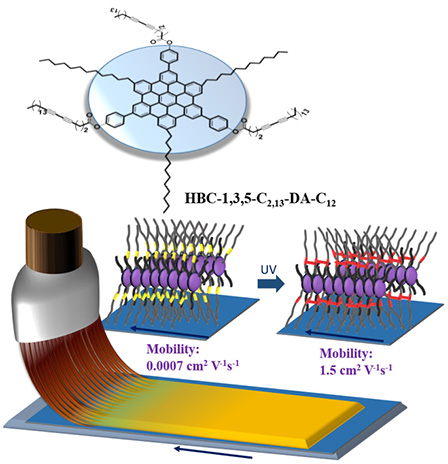
以有機分子做為電晶體的電荷傳導材料是當今發展軟性電子元件的關鍵;如何提升有機材料傳遞電荷的能力,亦是一大挑戰。而有機分子傳遞電荷的能力與它們在基版表面上排列的規則性與方向性有極大關係。 在本工作中,我們設計合成了一系列在六苯並蔻(hexabenzocoronene, HBC)核心周圍不同位置帶上三個雙炔基鏈與三個飽和烷基鏈的六苯並蔻衍生物,並將這些盤狀液晶分子以毛筆刷塗方式鋪排在矽晶片表面。以毛刷鋪排之分子薄膜呈現有方向性的排列,分子係以側向的方式站立,其分子間的π-π 堆疊方向則是沿著毛刷刷塗的走向;視雙炔基在其烷鏈中的位置不同而有六角形或者類似層狀的筒型結構堆積。以紫外光照射這些分子薄膜會導致筒內的分子間雙炔基交聯或者聚合,其中以雙炔基較接近HBC核心的分子所得到的類似層狀結構中,其HBC陣列排列的最緊密及規則,並產生沿著筒方向延伸的共軛聚烯炔鏈。以這種照光後的薄膜製備成的場效電晶體,沿著筒的方向之電荷遷移率可以高達1.5 cm2/V•s,比起沒有照過光的薄膜所製成的電晶體電荷遷移率高了千倍,對比於目前最常使用的無機非晶矽為主的電晶體材料電荷遷移率尤佳。 此一排列分子的方法,既簡單又節省材料,還可以進一步延伸到大面積上。透過分子結構的精密設計與排列方法的優化,未來可望應用在製作軟性電子所需的電晶體中。
A series of discotic liquid crystalline hexa-peri-hexabenzocoronene(HBC) derivatives carrying three diacetylenic side chains and three saturated alkyl chains at different positions around the central HBC core were prepared on SiO2 substrate by the Chinese brush-coating method. The brush-coated films of molecules exhibited anisotropic alignment, with an edge-on orientation and molecular π-π stacking along the coating direction on the surface. Hexagonally packed columnar structure or lamella-like columnar structure was obtained, depending on the location of the diacetylenic unit along the chain. UV-irradiation of the films resulted in cross-linking or polymerization of the molecular columns. Among them, the lamella-like structure with diacetylene unit closer to the HBC core gave more closely packed and ordered HBC arrays with the poly(ene-yne) backbones stretching along the column direction. Thin-film transistor based on this irradiated film gave a highest mobility of 1.5 cm2/V•s along the column direction, which is three order of magnitude improvement over that of the monomeric film.